


We are frequently asked questions about the Dekalin and Dekaseal products. These products are particularly well known in the camping and caravanning sector. We have compiled the answers to the most frequently asked questions for you.
Which is better, Sikaflex or Dekalin?
The question of which is better is always a matter of personal preference and depends entirely on which manufacturer the user prefers. Dekalin offers a wider range of products. Sika has a more compact range, but has now launched several new products onto the market, including Sikaflex 522, Sikaflex 554 and the new Lastomer 514.
Which Dekalin is suitable for caravans?
It’s difficult to give a general answer to that, as it always depends on the specific application. There is a whole range of Dekalin products for caravans and motorhomes.
Which Dekalin should I use for bonding? Which Dekalin should I use for sealing?
Dekasyl products are for bonding and sealing, whilst Dekaseal products are for sealing.
Which products are classified as adhesives and which as sealants?
How can I remove Dekalin?
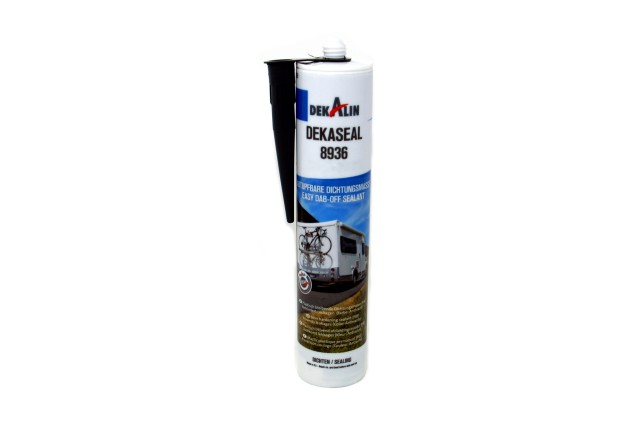
Dekaseal and Dekasyl products can be removed (whilst still fresh) using, for example, Dekaclean Ultra. Exception: Dekaseal 8936 can be dabbed off using the product itself.
Can Dekalin be painted over?
Dekasyl MS products can be painted over. The best results are achieved if the surface is painted over within 4 hours of application.
If you intend to apply a top coat more than 24 hours later, it is advisable to apply a primer first.
Which products can be painted over?
All Dekasyl MS products and Dekaseal 1512.
Which product can be dabbed on, and when?
Dekaseal 8936 can be dabbed off with the product itself immediately after application.
Which is better, Dekaseal or Sikaflex?
Dekaseal 8936 is a better product than Sika Lastomer 710: it has a higher viscosity, can be dabbed off very easily and quickly, and has lower water vapour permeability. It also produces fewer strings when applied. However, Sika has launched a new product: Lastomer 514. Lastomer 514 is equivalent to Dekaseal 8936.
Which Dekaseal for what?
Dekaseal 8936 is only intended for applications where mechanical fastenings (such as screws) are also used. Examples: service hatches, light fittings, sockets, skylights, etc.
Dekaseal 1512 can be used as a general-purpose sealant. It is suitable, for example, for skylights, floor penetrations, general floor sealing or securing side walls to the floor.
Which Dekaseal should I use for sealing?
It all depends on what you want to seal. Dekaseal 8936 is ideal for use with screws. For sealing without screws, we recommend using Dekaseal 1512 or a Dekasyl product.
What is Dekaseal 8936?
Dekaseal 8936 is a self-tamping sealant based on so-called polyisobutene (similar to butyl). Polyisobutene-based sealants have the lowest water vapour permeability and are therefore excellent for sealing structures that are also mechanically fastened, and for preventing water leaks.
How long does Dekaseal 8936 take to dry?
Dekaseal 8936 can be removed immediately after application. However, it is advisable to wait 1–2 hours, as more of the solvent will have evaporated by then. It dries solely through the evaporation of the solvent. Waiting a little while also means it is less likely to leave strings. Tip: It is also a good idea to let everything air-dry.
However, the vehicle can be driven again immediately after applying Dekaseal.
What is the shelf life of Dekaseal 8936?
At least 2 years.
When should you dab on Dekalin?
Dekaseal 8936 can be dabbed off in applications where the joint is also mechanically fixed in a visible area, such as side panels. It is advisable to first cut or scrape along the edge of the seal with a plastic card or a knife to ensure that no Dekaseal is removed from beneath the joint whilst dabbing.
How much Dekaseal is needed for a roof window?
For a 40×40 roof window, you will need approximately 220 ml of Dekaseal. Care should be taken to ensure that enough Dekaseal is used. Furthermore, after application, the part should be pressed down firmly to ensure that it is completely sealed and watertight.