


Table of contents
What is a pressurised container for self-filling?How must a pressurised container for self-filling be installed before it can be refuelled?
What are the specifications for the safety coupling?
What applies to commissioning and periodic inspections?
Will there be grandfathering for existing gas tank cylinder systems?
The new DVGW G 607 worksheet, which regulates the operation of LPG systems in leisure vehicles, is expected to be published in summer 2026. It is becoming apparent that new rules for the installation of gas tank cylinders will also apply. In future, this type of cylinder will be listed in G607 under the term pressurised container for self-filling.
NOTE: The new regulation often communicated in industry circles as the „new regulation for gas tank cylinders“ refers to the revised version of worksheet DVGW G607. The legal basis for testing in accordance with DVGW Code of Practice G 607 is Section 60 (1) of the German Road Traffic Licensing Regulations (StVZO).
What is a pressurised container for self-filling?
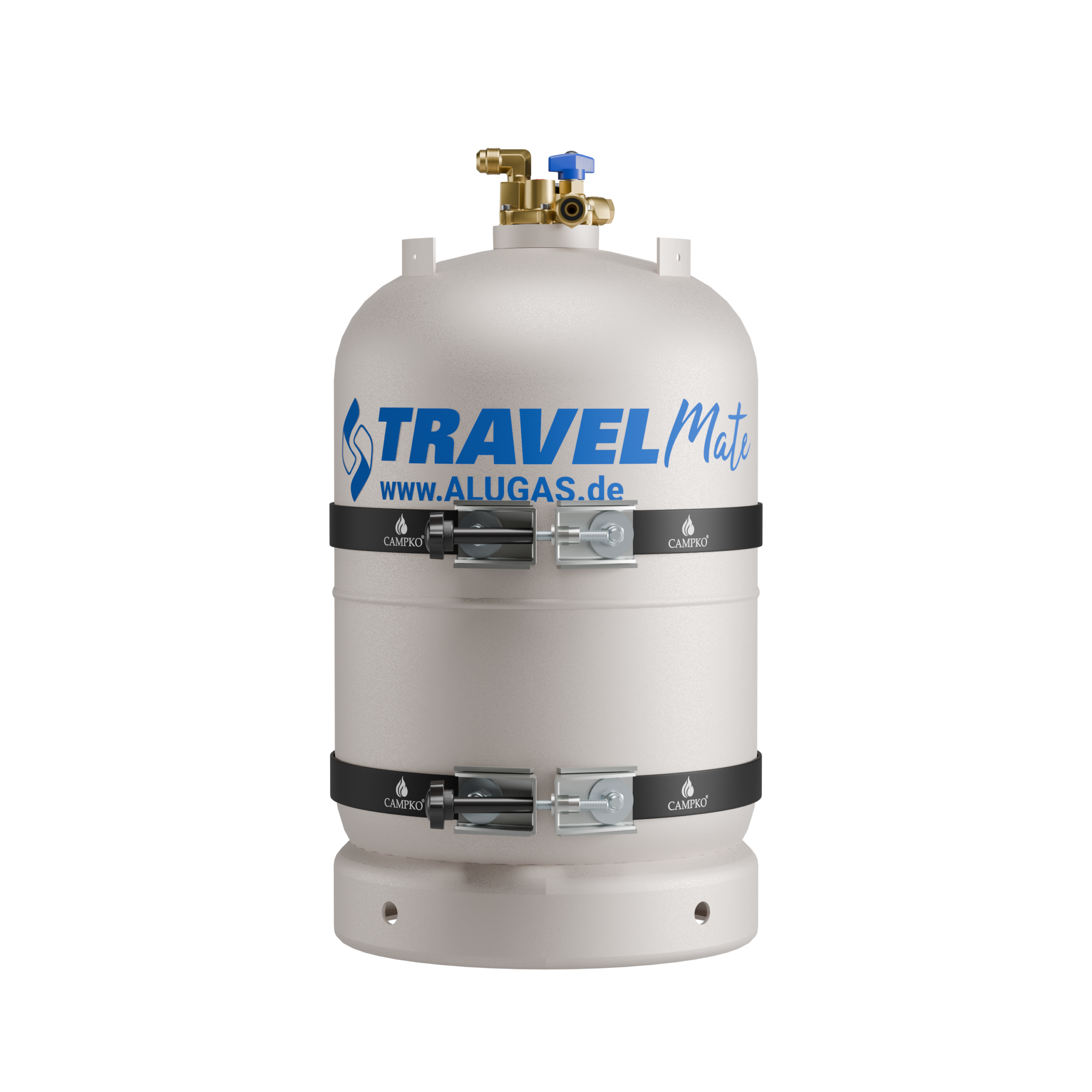
The new G607 defines this as a gas cylinder with CE marking (pressure vessel in accordance with Directive 2014/68/EU) that is technically designed to be filled with LPG at public filling stations (with filling fittings in accordance with UN Regulation No. 67 from the 01 series of amendments). At the same time, the cylinder is considered transportable (in accordance with the definition of LPG cylinders in DIN EN 1949).
A pressurised container for self-filling must have the following components/functions:
- 80% fill stop valve,
- Level indicator,
- Manual or remote-controlled shut-off valve,
- Filling connection,
- Filling connection line with safety coupling
- Safety valve.
The corresponding approval as an assembly including valve ensures that all Alugas TRAVELMate containers (tank cylinders) fulfil these requirements.
How must a pressurised container for self-filling be installed so that it can be refuelled?
An LPG fuelling nozzle for the system must be fitted to the outside of the vehicle and at least 500 mm away from
- a ventilation system for the living area/living space,
- an openable part of a window,
- any exhaust gas outlet
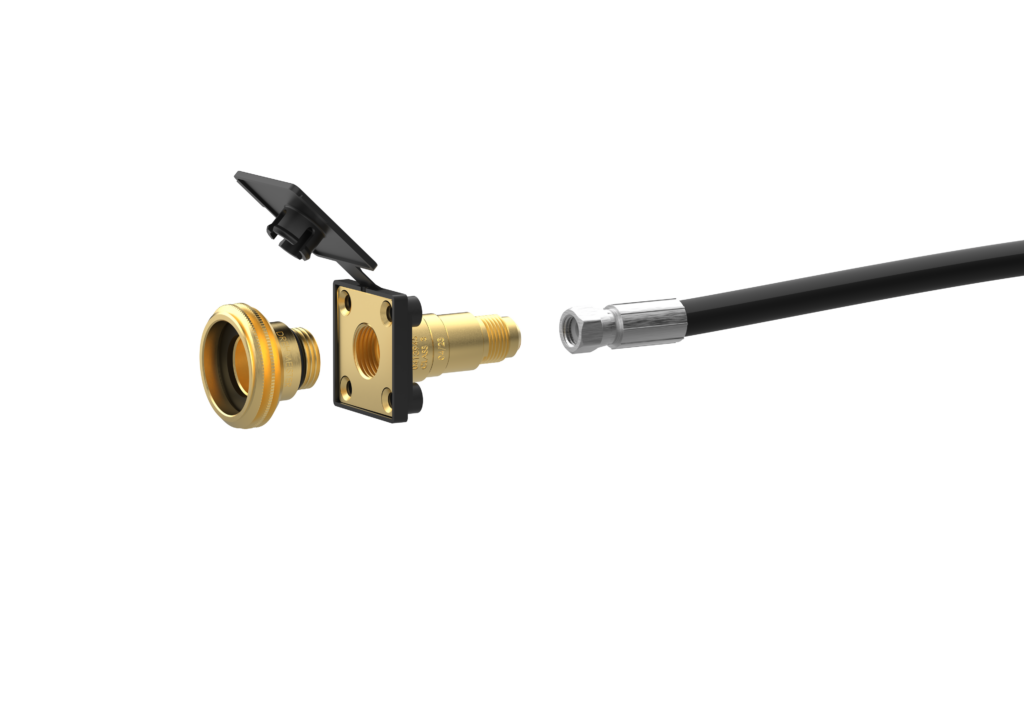
A suitable LPG filling hose must be attached to the LPG fuelling nozzle, which must not be routed through the interior of the vehicle. A safety coupling (see below) must also be installed between the LPG fuelling nozzle and the gas cylinder.

As the gas cylinder is always considered transportable, it must be secured in such a way that it can be removed without tools. This can be ensured using the CAMPKO gas cylinder holder including easily detachable star grip screws , for example.
A notice with the following content must be affixed in the bottle crate:
- „Pressurised container must not be removed.“
- „Refuelling only permitted in a fixed state.“
- „Do not destroy the seal of the installation. „
A corresponding information plate is supplied with all aluminium gas quick couplings.
What are the specifications for the safety clutch?
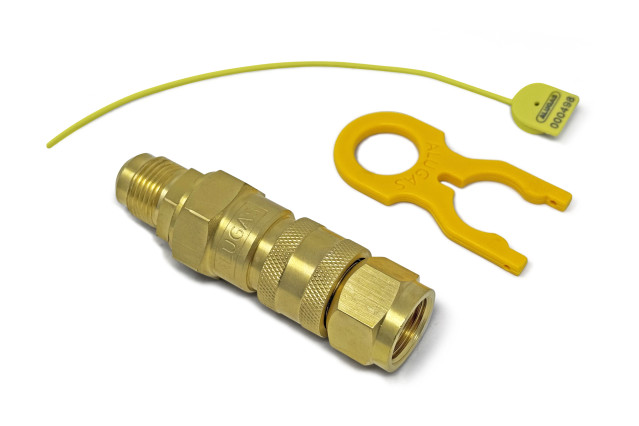
A safety coupling must be installed between the LPG filling hose and the gas cylinder, which must be both detachable and able to close automatically if the connection is interrupted. A double non-return valve is not required, as the multi-valve already has its own non-return valve on the cylinder side. However, it is crucial that the components and sealing materials used for the quick coupling are specially designed for permanent contact with LPG and can withstand this in the long term. If this condition is met, the coupling should be labelled with an LPG marking.
To ensure that the safety coupling is installed correctly, it must be sealed. The ALUGAS quick coupling therefore has a safety element with a seal. The seal may only be applied by a G607 expert after appropriate testing, not by private individuals.
In addition to the requirements of G607, the manufacturer’s specifications in the installation and operating instructions for the cylinder system must be observed.
What applies to commissioning and periodic inspections?
A test certificate must be issued for the LPG system, which must state that the system complies with the provisions of G607. Remaining test certificates that do not yet address the specific requirements of pressurised containers for self-filling can still be used within a certain period of time by manually adding the relevant content to such cylinders.
It is advisable for installation companies to instruct the customer in the operation of the system when the vehicle is handed over (e.g. as part of the initial filling of the system) and to have this confirmed in writing.
A 10-year inspection period applies to the pressurised container for self-filling. This means that the tank must be returned to the manufacturer for testing after 10 years. The customer will probably receive a corresponding replacement container from the specialised companies, which can then be used for another 10 years.
As pressurised containers for self-filling are legally regarded as cylinders that are not part of the vehicle for the purposes of the main inspection, they are not relevant for the main inspection.
Will there be protection for existing gas tank cylinder systems?
No, there is no grandfathering for existing systems. These must be adapted to the new requirements by the next G607 date at the latest. Only an appropriately retrofitted system can also receive a G607 inspection sticker.
We are constantly working on the further development of our products. Please understand that no claims can be derived from the information, illustrations and descriptions in this documentation. Errors and technical changes excepted.